
Elected Republicans Who Know Better May Be Cowards, But They Aren't Irrational
Lessons From Dan Crenshaw, Thom Tillis, and Liz Cheney

In our Looney Tunes existence, soon-to-be-former Texas representative Dan Crenshaw apparently qualifies among primary voters as insufficiently loyal to the Republican Party, and has been summarily purged. Unsurprisingly, most of the commentary I’ve seen about Crenshaw, whose brown-nosing toward the president in the run-up to the vote was especially humiliating, even among those who know better who nonetheless feel compelled to seek Trump’s favor, has not been sympathetic. (My vote for most degrading goes to the failed Jeff Sessions campaign to win back his old Senate seat, FYI.)
This result intersects instructively with the recent liberation of retiring North Carolina senator Thom Tillis, free to speak the truth about the gallery of fanatics and fools hired by Trump to do his bidding — now that he is no longer accountable to the Republican primary voter. Retirement has been a popular route to such freedom under Trump: Bob Corker, Mitch McConnell, Jeff Flake, and others can tell us all about that. At first glance, this about-face seems to reveal something awfully cowardly: it’s hard not to conclude that until they announced their exit from politics, these senators lied about their beliefs and observations, and told people what they want to hear, like a caricature of a politician. How brave is it to speak your mind only as you’ve rendered yourself no threat to anyone and therefore need not fear making new enemies?
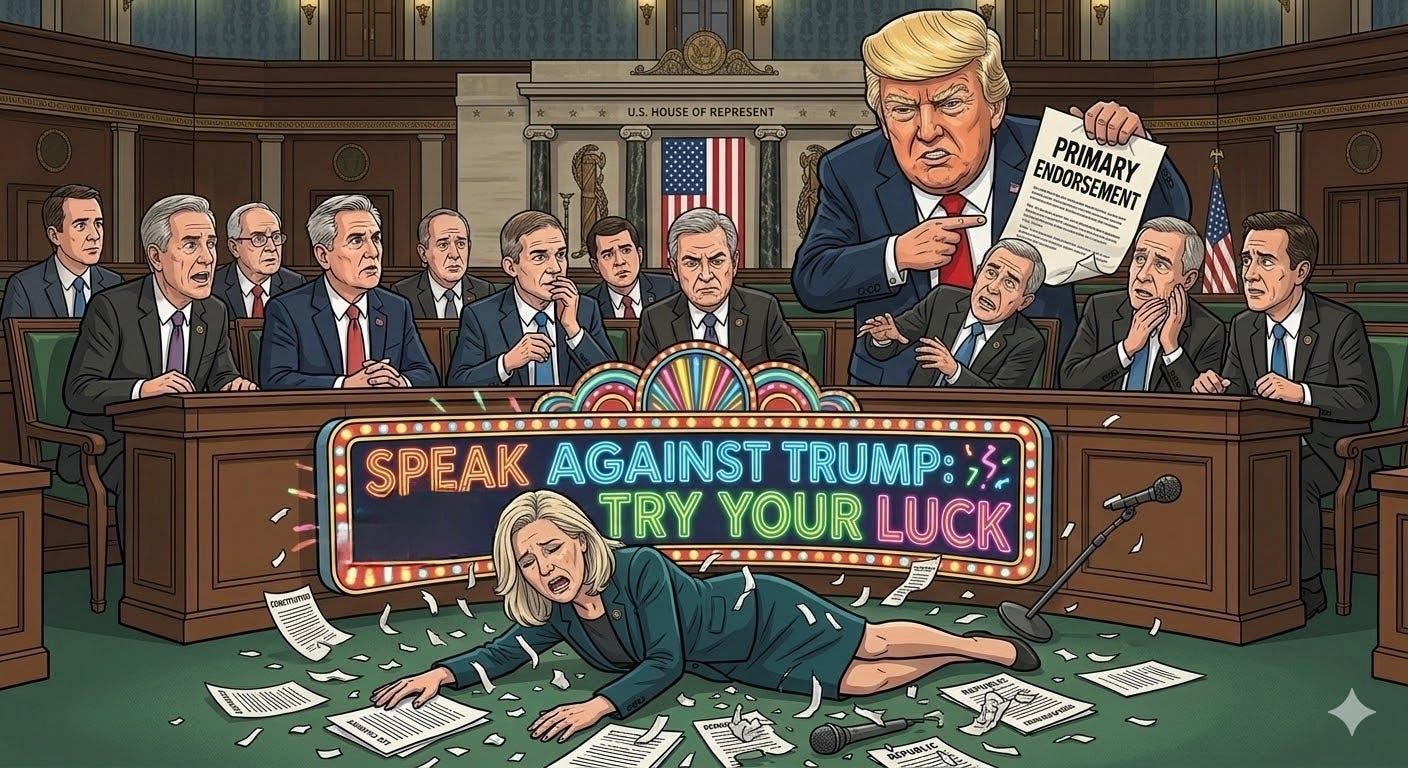
I can’t go as far as to say that these people have been justified in their conduct, but I do think it is more defensible, or at least rational, than it first appears. For one: the result of speaking the truth in today’s Republican Party is not a mystery, or a hypothetical question. Liz Cheney had represented Wyoming in the House for a long time, she had an unimpeachable party pedigree, she had been considered a potential challenger for the Senate from the right in 2014, and she constantly argued against Trump from conservative premises. She spoke out loudly and frequently to anyone in her party who would listen to her case, fighting to the last day for every possible primary vote in a state where it’s still possible to speak personally in a year’s time with most persuadable primary voters. She had the courage to carry her observations to their logical practical conclusions, and insisted it was time to put party over country: she worked with Democrats on the January 6 Committee. She did everything she is ‘supposed to’.
She got her ass kicked, 2-to-1, in her primary, and now she has no power at all. Few now care about what she thinks who aren’t already persuaded.
Is it really so irrational for a Republican in Congress who knows Trump is a menace to look at Liz Cheney and ask what the point of imitating her would be? Yes, Wyoming is a particularly conservative state, but: two-to-one! When she was a cause celebre! If the practical effect of speaking out is to immediately be replaced with someone crazy (even crazier), why should someone who will put his foot down when it really counts (so they tell themselves), or at least not hector Trump to be even more erratic, volunteer for an electoral suicide mission? Republicans in Congress are accountable first of all in every election cycle to Republican primary voters, not to reporters, historians — or Democrats. If Dan Crenshaw’s mild apostasy will get him purged by double-digits in a primary, what hope is there, really? The voter, not the special cowardice of these individual elected Republicans, is responsible for their failure to speak out. Thom Tillis voted to convict Trump for his crimes on January 6th, just two months after winning re-election in 2020. He probably knew then that he would not be running again in 2026 if Trump managed to retain his dominance as head of the party. The practical effect of defying Trump as an elected Republican is almost always to be issuing a resignation letter to the world.
This isn’t to say that these people aren’t cowardly. There are a lot of unknown factors that could come into play if the number of credibly right-wing elected Republicans speaking out against Trump were to hit a critical mass. And in practice, very few of these people ever really put their feet down. This is all simply to note that their behavior, while pathetic, is anything but irrational. Few people — and certainly few ambitious people — want to stick their necks out for what they know is a lost cause. That’s calculating and craven, sure. But it’s not something anyone should assume they wouldn’t do if they found themselves in a similarly impossible situation. It isn’t a viable way to approach ethics to render it mandatory for someone to self-immolate in exchange for nothing.