
Why Fighting the Two-Party System Is (Almost) Always a Waste of Time, Pt. 1
It's not about corrupt insiders or people's inability to think for themselves

The reason electoral politics in the United States consists almost exclusively of contests between a Democrat and a Republican is, in a certain appropriate sort of American fashion, not the result of malice or corruption, but of a sort of bureaucratic necessity. I speak to readers from time to time who have voted for third-party nominees for the presidency in the general election — who ridicule me for voting for Democrats on the basis that they’re much less bad than Trump — and they all seem mystified that the overwhelming part of the population is needlessly in thrall to these two behemoth parties. How can they keep commanding the electorate’s nearly undivided attention, despite both of them failing the people repeatedly, and with such stunning mendacity, incompetence, and short-sightedness? What could it be?, they must ask themselves. Are people really that monkey-brained that they are overwhelmed by the enormity and pedigree of these parties, with shockingly few people truly willing to think for themselves? Is it that our corrupt corporate-owned media simply refuses to pay attention to anyone without an R or D next to their name? Is it that people are so ideologically brainwashed that they really think anything not espoused by one of these entities is by definition reckless or frivolous?
The real reason is one that the Founders themselves didn’t appear to anticipate. Any serious national political party in the United States will have to compete for the presidency. If your political party has no organization or viability at the presidential level, there’s little point in rallying around that banner. A party that cannot ever expect a turn at the presidency will not be able to make lasting, meaningful changes to policy. But our Constitution requires an electoral majority — that is: a majority at the electoral college — to win the presidency. There is a route to the presidency that does not entail winning an outright majority: if none of the nominees win an electoral majority, the decision is made by the House, with each state getting one vote. Needless to say, there is no possibility of organizing a political party around that process.
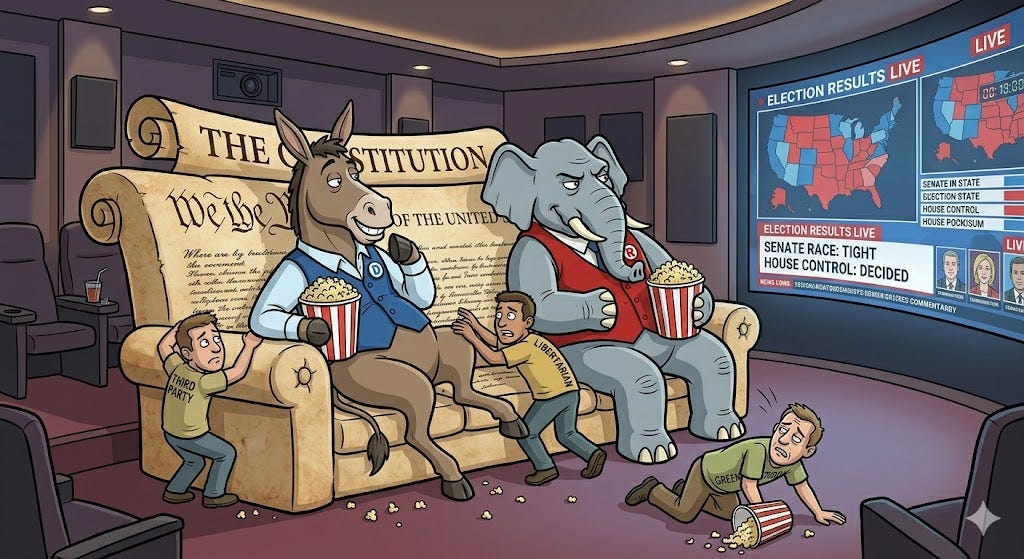
The logical, inevitable outcome of a system that requires an electoral majority to win the indispensable office is a competition between two and only two parties. The incentives to consolidate are overwhelming. Any defection by any significant faction might spell doom for a party in a given cycle, because the electoral college does not punish a candidate for winning by 0.1% nor reward a candidate for winning by 30%. Therefore the impetus to party discipline must be strong, since a seemingly marginal defection or protest on one side may result in the other side winning it all. Like the state-by-state process at the electoral college, the presidency is a winner-take-all prize. So it’s no mystery why disproportionate anger is often channeled at third-party voters when a lost election was particularly close. It’s not hard to believe that if Ralph Nader had not run in 2000, Al Gore would have won Florida by a whisker instead of George W. Bush.
Of course, it is not just the presidency that requires a majority. In many states, if no nominee in a general election wins a majority, the top two progress to a run-off: a majority is required against an alternative to win. No political party can hope to become viable when it can’t meaningfully contest every major race at every level of government because it is dependent on winning pluralities against a perpetually-divided opposition. The presidency is merely the dealbreaker for any arrangement: this is just a peek into what can be found if one goes one level lower. For a look at how a dynamic like that can result in a lopsided loss, one may examine the French presidential elections about a decade ago featuring Marine Le Pen, whose party can win a plurality in a sort of free-for-all, but has a low ceiling in a one-on-one contest. T
There is another misunderstanding — perhaps I shouldn’t say misunderstanding, but I think it is a pig-headed way of approaching the matter if held to consciously — along the lines that voting is an expression of one’s innermost conscience. That we cannot be expected to hold our noses for lesser-evils, who, after all, are still evil, while we should be demanding health. I have no respect for this view. This just is not how coalitions work. Your vote is your little pawn piece on the grand chess board. It’s your tiny little speck of power in the vast nexus of our democracy. It is not an expression of your moral convictions. It’s a context-dependent practical choice affirming one candidate as being superior to the other.
It’s also peculiar to accuse the two parties of having a monolithic chokehold on the way Americans think, when the parties themselves are constantly morphing, and 30 years’ distance will always leave large numbers of people feeling like they aren’t at home in their respective parties anymore. It really is possible for an ordinary person to catch a complacent incumbent asleep at the wheel in Congress; it really is possible to create a movement where one otherwise wouldn’t have existed through a primary campaign within one of the major parties; it really is possible to change the general ideological direction of the party through sustained argument — all through mechanisms within the parties. Alexandria Ocasio-Cortez did it to Joe Crowley, then the party forgot Crowley overnight and found room for the insurgent. Bernie Sanders filled a void in the 2016 and 2020 campaigns when it was far from inevitable that that void would be filled. So the image of the parties as being immovable, static monoliths imposing manufactured consent on the sheeple just doesn’t hold. They do, however, demand compromise, which has been at the heart of this country’s ideals — when we bother to have them — from the beginning. The Constitution itself, of course, is a product of the art of compromise. It makes it possible for all of us to live together — and the practice of dealing with a diverse cross-section of opinions and demographics in party politics is itself a sort of education in the art of compromise. Parties force us to work with a large coalition of our fellow Americans.
That obviously doesn’t mean all of this can’t be dysfunctional or even that it won’t downright malfunction sometimes. There are good arguments for expanding the size of Congress, or even switching to a parliamentary system, for instance. But the structure of the two-party system is not the result of an insider-driven scheme to prop up a corrupt duopoly, while all that the American people would need to do to get rid of it is wake up from the spell cast on them and demand better. The spell maintaining our two-party system is so strong, in reality, because it carries the mandatory enchantment of being an inevitable outcome of our political system’s structure. If you want to make it possible for third parties to compete, make it possible to win the presidency without an electoral majority. Until then, the only times when it is rational to vote in a general election for a third party nominee are those you’ll know when you see. But those circumstances are almost always idiosyncratic, almost never a pattern for a future independent nominee.
(To be continued…)